


EURUSD in 2026: Rate differentials and risks
* Trading is risky. Your capital is at risk.
At the start of 2026, the EUR/USD thesis looked about as clean as macro gets.
The Fed had cut three times. The ECB stopped in June 2025. Capital follows yield, the differential was open, and the institutions: Goldman, ING, BNP, MUFG - were all pointing in the same direction.
Then 2026 happened.
The Middle East war pushed oil up by over 80%. Eurozone inflation, which had briefly dipped below the ECB's 2% target in January, reversed sharply. Markets that were pricing ECB cuts at the start of the year are now pricing hikes. The Fed, meanwhile, has been on hold for three consecutive meetings, stalling the cutting cycle that was supposed to be the engine of euro strength.
The rate differential framework hasn't broken. But it has been tested in exactly the ways this kind of analysis tends to underestimate by geopolitics rewriting the policy outlook faster than any central bank model can track.
So this EUR/USD analysis is built around the differential, because it remains the most important structural driver over any medium-term horizon.
But it comes with caveats that the start-of-year consensus largely skipped: the Fed pause and potential hike is real, the ECB tightening risk is real, and geopolitical headlines may be here to stay. The framework still works. It just needs to be held with both hands.
Key takeaways
Success in the forex market means understanding the fundamentals, picking the right broker and platform, and building a strong trading plan.
Managing risks is key in forex trading. Using stop loss and take profit orders is vital to safeguard investments.
Managing risks is key in forex trading. Using stop loss and take profit orders is vital to safeguard investments.
Why yield differentials drive currencies: the mechanics
Ok, quick recap. Why does rate differentials predict price movement?
Money flows toward the highest risk‑adjusted return. It’s not always in a straight line, but over any medium‑term horizon, institutional capital follows yield.
To be precise: we’re talking about the short‑term policy rate differential — the Fed’s target range (currently 3.50–3.75%) versus the ECB’s deposit facility rate (2.50% since June 2025). This is the rate that trillion‑dollar cash portfolios watch for 0-to-12‑month roll decisions. Short‑term differentials drive FX carry. Long‑term bond spreads do not.
When the Fed cuts, dollar‑denominated yield falls. Global managers rebalance toward euro assets — not because Europe looks brilliant, but because the arithmetic of relative yield moved. That demand pushes EUR/USD higher.
Goldman Sachs quantified the relationship with a crucial nuance. Their research estimates that every 50bp of narrowing in the Fed‑ECB short‑term differential adds 300–400 pips to EUR/USD. That is a useful average. However, the impact is not linear.
At today’s moderate Fed range (3.50–3.75%), each cut reduces dollar yield by ~7%, a bigger proportional hit than when rates were above 5%. The next 50bp of narrowing will likely add more than the last 50bp did. And as rates near 2.5%, the ECB’s neutral floor creates asymptotic behaviour.
So, if you know the direction of the short‑term differential — and understand that its price impact accelerates as the Fed eases further — you have a calibrated, non‑linear framework. Not a guarantee, but a quantified expectation.
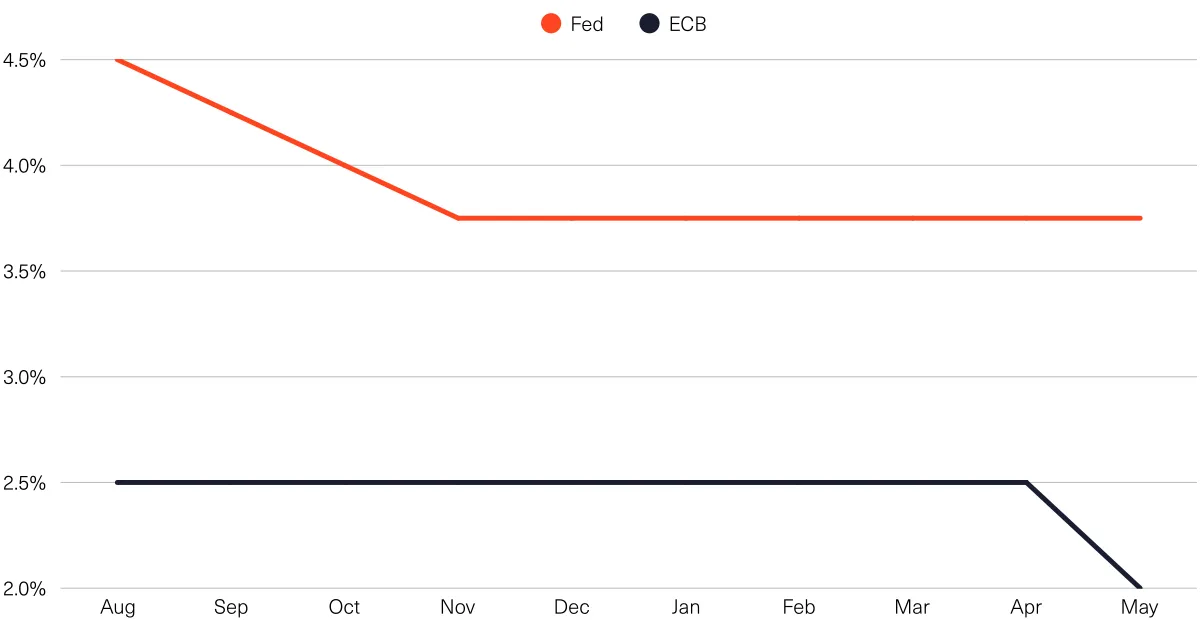
Fed v ECB rates - Last 12 months
Where each central bank stands in 2026
The Federal Reserve cut three times in late 2025, bringing the federal funds target range to 3.50–3.75%. But that cutting cycle has since stalled. The Fed has held unchanged rates at three consecutive meetings in 2026 — January, March, and April — as policymakers navigate a more complicated inflation picture than the year-end consensus anticipated.
With oil prices rising and some FOMC members flagging that further hikes could be warranted if inflation persists, the accommodative posture that looked like the 2026 baseline has become something closer to a wait-and-see pause. Markets are currently pricing no further cuts in the near term.
The ECB's position has shifted just as meaningfully, though in the opposite direction from what most analysts expected. The bank cut rates eight times between June 2024 and June 2025, bringing its deposit facility rate from 4% down to 2% - a level most economists consider close to neutral. It has been on hold since. But the ECB is no longer simply parked in a benign holding pattern. The outbreak of conflict in the Middle East in late February pushed oil prices up over 50%, reversed what had been a brief dip below the 2% inflation target, and forced Frankfurt to reassess. Eurozone headline CPI came in at 3.0% in April.
Markets are now pricing an 85% probability of at least two 25bp ECB rate hike by December 2026, a complete reversal from the cuts that were being priced just months ago.
Both central banks are on hold. The Fed's next move is genuinely uncertain. And the ECB, rather than staying parked while the Fed cuts, may now move first, potentially in the direction of tightening.
The asymmetry between the two banks hasn't disappeared, but it has become considerably more complicated. That changes how you hold the rate differential framework, not as a mechanical trade with a known direction, but as a live variable that requires active monitoring of both sides of the equation simultaneously.

The risks (and why they don't change the engine)
A rate differential is a live variable, not a permanent fixture. Two scenarios can close the gap, and both are worth modelling explicitly before you trade.
The first is a Fed pause or potential hike. If US employment data hardens through Q2 2026, or if core inflation re-accelerates, the cutting cycle could stall.
Markets are currently pricing potential hikes which would reprice EUR/USD faster than any technical level provides support and it's the higher-probability risk on this list. It's also the scenario most likely to support the USD.
The second is an ECB cut. If Eurozone growth deteriorates materially, or if inflation prints consistently below 2%, Frankfurt could shift to an accommodative stance and narrow the differential from the other end, though this is unlikely given the conflict-induced inflation.
Neither has materialised. And the analytical approach doesn't change regardless: track the differential, not EUR/USD in isolation. Watch the Fed funds futures curve. Watch ECB deposit rate expectations.
The trade is mechanical, not speculative
EUR/USD analysis in 2026 doesn't require predicting geopolitics, reading sentiment surveys, or finding a pattern in a daily chart. It requires knowing where the differential is and where it's going because everything else is downstream of that.
The Fed cut. The ECB held. The gap opened, and capital followed the yield. ING has a fair value target. Goldman has a pip-per-basis-point estimate. BNP Paribas and MUFG are in the same camp. That relationship of policy divergence driving capital flows to driving price has held across every major monetary policy divergence of the past 30 years, and it's holding now.
If you've been waiting for a cleaner macro read on EUR/USD, this is about as clean as it gets.